Mom explains. “As in the book, Teddy, adopted means you are a special boy. We chose you.”
A summer morning. All my energy resisting the urge to run. Knew I had to wait.
Mom closed and held The Chosen Baby gently in her lap. The edges of its small, drab brown cover worn bare. I knew every line. I knew when we were in the middle, close to the end, and how it ended. Tension rising as escape came closer. The fishpond and my sailboat waiting.
Waiting, I knew she needed to say what she always said after she closed the book.
“They weren’t able to give you what you needed. They wanted you to have a better life.”
Waiting, the tension to escape almost impossible now.
“I can see you want to play with your new boat.” And, smiling: “You can go play.”
Escape.
I’m up. Across the room in a couple strides. Into the kitchen, where my pond boat rests, its mast leaning against the wall next to the fridge, and Mom says softly, “I love you so much, Teddy.”
And I know I must say, and I do, “I love you too, Mommy.”
Out the door and down the steps, freedom.
* * *
Dogma. Indoctrination. Brainwashing.
Looking back, that feels like the truth of it. But as I write, I feel the guilt from telling. Guilt so familiar it seems like an old friend.
I contributed. Went along with it. I participated in the charade. The pain of it all feels as much my doing as theirs.
Mom never called my birth mother “she.” Not once.
Now I suspect Mom feared that somehow, she’d lose me if my birth mother became a presence. If we discussed her, or speculated about her life, somehow she might become a threat. Somehow, I knew never to question this absence. Somehow the pronoun she itself was too risky.
And then this fiction: Mom said I’d been held in a hospital for my first five months with a heart murmur. The county social worker recorded that I’d been placed with a “Care Mother.”
* * *
Tom, my first therapist, leaned back and made a little house with his hands. “Ted, you separated from your parents at five or six. That’s far too young.”
Pride swept through me. Pride, that I’d been capable enough to go it alone.
Then the fear. Damaged goods. Unfixable.
I said nothing, thinking, okay, too young, but I soared past those people.
Later, another session. “That Care Mother saved your life. Without her physical care — feeding, holding, rocking you to sleep — you’d have been severely damaged.”
I was forty when I heard that. I’m about to turn eighty-one now — forty years of understanding.
* * *
I was born in Centralia, Washington, to Hazel Beeching. I was her second child. She was only twenty-one. Hazel named me Charles before giving me up.
After Mom died, I found a baby book carefully recording my first smiles, stress rashes, and development in careful, girlish cursive. The hand of a loving “Care Mother” who called me “her little Chucky.”
* * *
The adoption contract required that I have my own bedroom.
When I was three, Mom borrowed from her mother to buy two houses a block apart on Seattle’s Beacon Hill: a small one for Grandmother, ours larger, with three bedrooms.
Grandmother was a monster.
Mom’s sister Barbara wrote, “…when rage fully engaged, Mother would grab first Betty and next me by the hair and swing us around the room. I was terrified that she’d lose her grip, and Betty would fly into the wall and be killed. Betty was all I had.”
Barb left home at fifteen on a motorcycle. Betty became a top student, meeting every need she could.
* * *
Grandmother, from her wicker porch chair: “Teddy, it’s two o’clock. Time for your piano.”
I’m four.
She carefully moves her cane from across her lap, putting the lower end with its rubber cup on the floor, and rises slowly. Leaning forward, both hands on the cane, she begins down the steps.
I wait; my toy truck, the soft dirt, the warmth of the sun; I’m happy here.
Grandmother is midway down the porch steps.
No piano, I think. She can’t catch me.
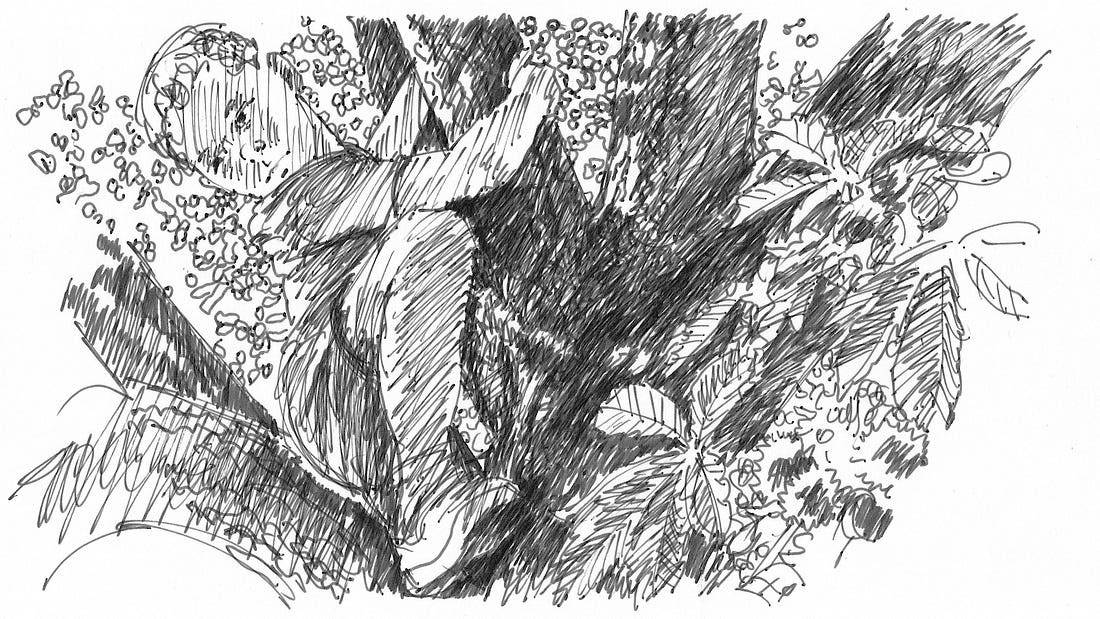
I spring to my feet and into a run. Across the weedy yard, down the bank, across the street, her voice behind me, growing faint. Full speed now, knees pumping, past the neighbors’ houses, to the base of my chestnut tree. I climb into the deep green place where no one can see me.
And wait.
Dad found me after dark. Got the ladder, coaxed me down.
* * *
Soon after, Mom had him committed. A WWII Pacific vet, I suspect PTSD; Mom called it a breakdown. She took a teaching job in Olympia. I stayed with Grandmother that year — more encounters with the cane — until Mom and Barbara shipped Grandmother off to Hawaii, convinced she’d caused Dad’s collapse.
Dad came home to his old job at Sears, but I wasn’t allowed to live with him alone. So, during my school years, I lived first with Grandmother, then with a church family, then with a woman named Mimi.
We reunited as a family the second time I went through fourth grade — I hadn’t been reading at level.
During those years I dreamed of escape. I was lost English royalty, Robin Hood, King Arthur, Huck Finn. Prince Valiant and Lewis and Clark. Later, radio, magazines, movies, TV — all of it revealing style — people far cooler than the Leonhardts, and a way to live that would separate me from them.
So, it’s no surprise I found illustration and design. Four years in Frank Fujii’s high school commercial art class, then the Famous Artists course, then The Burnley School of Professional Art.
As a young adult, my relationship with the Leonhardts became somewhat like the professional connections I had with clients and colleagues.