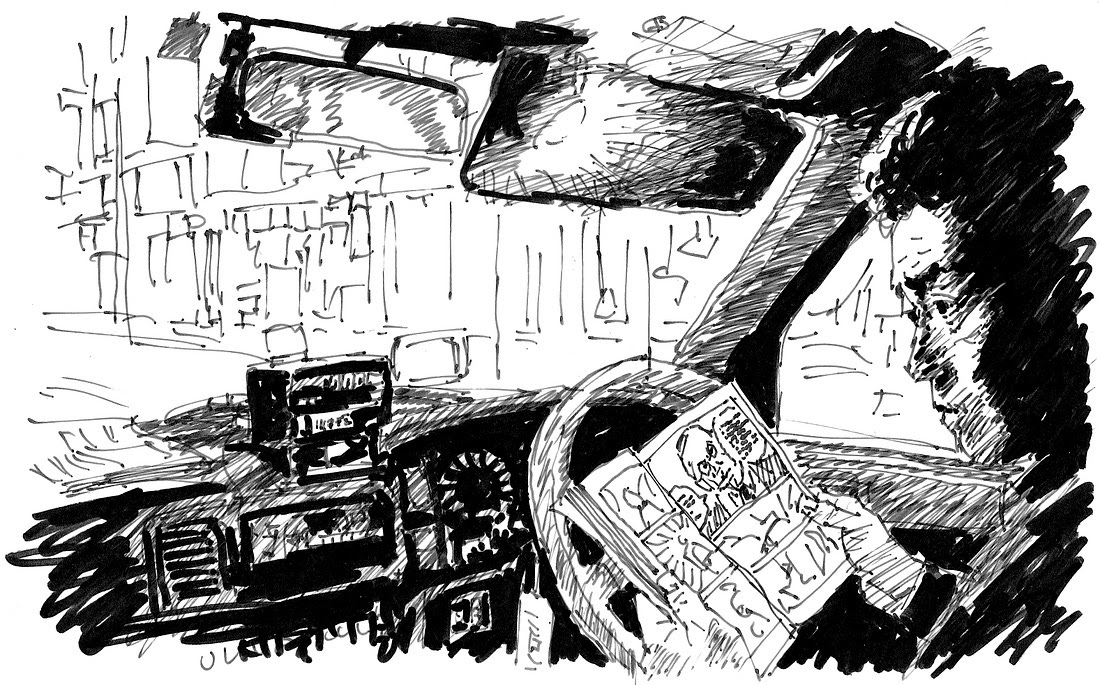
Tokyo, 2000. Stepping into a cab, I see the driver reading a comic.
It’s manga, a Japanese comic book. The protagonist is a short, dark-haired exec, with an intense look. I recognize him. It’s Carlos Ghosn.
At the time, Ghosn was eighteen months into one of the most dramatic corporate turnarounds in business history. He’d arrived at Nissan in 1999. Nissan, with $19 billion in debt, weeks from bankruptcy, and structurally stalled. He’d cut 21,000 jobs. Closed five plants. Eliminated the impossible-to-manage cross-shareholding relationships.
And he’d learned Japanese.
A hero to Tokyo cab drivers. The manga, proof.
Nissan hired my firm to solve a problem that looked like a branding problem but was actually an organizational one.
Nissan didn’t have a brand. It had three.
In Japan — home, but most resistant to change — there were Red dealers, Blue dealers, and White dealers. Each had its own series of car names. Consumers knew the car names. They barely knew they were Nissan cars. In the world, the Nissan name and logo were at least nominally present, but wildly inconsistent across markets. The eighties change from Datsun, still a shadow.
A house of brands, in brand-strategy terms. The visual fragmentation was real… but it was a symptom.
The deeper problem was that Nissan didn’t cohere as an organization. The brand just made it visually obvious.
So: move them from house of brands to branded house. One name. One mark. One global visual system, applied everywhere, to everything, immediately.
Jean-Jacques Le Goff, the French executive Ghosn had appointed as Senior VP of Marketing, was my client. He understood what we had to do and had backed us completely throughout.
On the day of the global presentation, just before we walked into the room, Le Goff put his hand on my shoulder, looked me in the eye, and asked if I was ready.
I told him I was.
I was nervous. But I knew I had their confidence. And that knowledge — that someone with authority and skin in the game had looked at me and said, in effect, we chose you and we believe in you — is what allowed me to walk into what came next with the steadiness it required.
The room held Japanese dealers and Nissan senior management, as well as dealers and executives from around the world, via video. My presentation was interpreted simultaneously into five languages.
I presented standing beside Carlos Ghosn.
When I finished, Ghosn opened the floor to questions. He answered for twenty or thirty minutes. Some questions, he answered in Japanese. The resistance in the room — and there was resistance, particularly from the Japanese dealers whose entire identity was about to be unified away — surfaced and was addressed.
Then Ghosn said, “We will adopt Mr. Leonhardt’s plan globally. Thank you very much for your time.”
He turned, smiled, shook my hand, and left.
Complete acceptance followed. I suspect everyone in the room had known this would happen. Ghosn had been eliminating suppliers, closing plants, and letting people go for eighteen months. He’d learned their language. He was a character in their popular mythology. The question in that room was never whether the plan would be adopted. The question was whether the meeting would be gracious or difficult.
It was gracious.
A Note on What Came After
Ghosn was pushed out in 2018, accused of violating Japanese laws on executive compensation. Arrested. He later escaped Japan in the dead of night, hidden in a large speaker box and flown to Lebanon.
Since, Nissan has endured a major sales decline and intense structural upheaval. It’s now undergoing an aggressive downsizing effort to survive.
The man who demanded coherence from an entire global organization apparently couldn’t hold himself to the same standard. And it didn’t outlast him.
Imposed unity is fragile. It leaves when the person who forced it leaves. Cultural unity — built from the inside, over time — is more likely to survive.
What he built didn’t survive him. The lesson did.
A Confession
At the time, I didn’t know what I was part of. I could feel what I should do and say… but I saw it as a branding job. I didn’t have language for what I was doing, or where that capacity came from.
I do now. That’s what twenty-five more years and a book will give you.
The work I do now — inside creative firms, with founders and the people around them — is the same work: Helping organizations see what they can’t see about themselves. Making the invisible cultural problems visible before they become visible as collapse.
Ghosn needed someone who could stand beside him and present the organization’s future to itself.
Most creative firms are still waiting to be asked.
The ones willing to say they can do it — will.