Becoming: Given Up
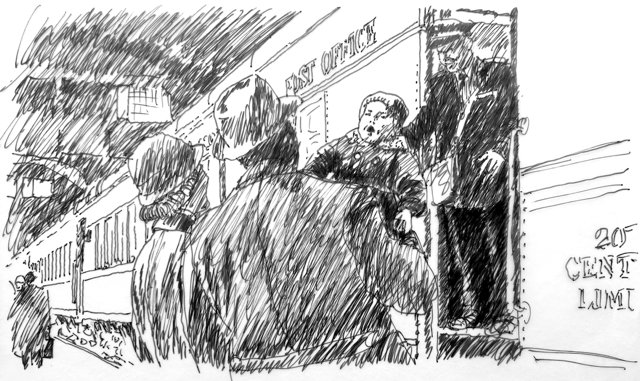
The Chicago train platform — gray light, the chill of the morning, and a whiff of diesel. A crunch of couplers. Iron against iron reacting to the pull by an unseen engine on a long line of passenger cars.
We waited alone, beside a train not yet ready to be boarded, Mom, Dad, and me. We were early.
Suddenly, Dad’s hands gripped my waist, and he lifted me high into the air. I must have been three. I remember the surprise of it, the rush of cold air against my face, and then I was in the hands of a stranger standing at the top of the mail car steps — a man in a nickel gray uniform, his cap tilted, his arms strong, but unfamiliar.
He laughed and said something cheerful. My father laughed too. The train jerked, couplers crunched, and we rolled forward. I screamed.
I knew — I knew — I was being given away again.
That certainty, I’m sure, came from somewhere deeper than memory. Nancy Verrier called it a Primal Wound in her book by that name — a reflex reaction built in long before words. I’d been handed off many times by then, though I couldn’t have counted them. But my body remembered. The panic, the sudden heat under my skin, the sense that my world could vanish in an instant. The train only moved a few feet before stopping, and my father reached out to take me back, concerned at my distress, although not knowing what he’d done. But something inside me had already shut tight.
Now, when I think about that day, I see how well I learned the lesson: don’t trust the arms that hold you — they might not be there when the train starts to move.
My skin spoke the language of distress before I could. Red, inflamed, erupting whenever threatened. The doctors called it dermatitis, an allergy, maybe nerves. Whatever it’s called, it’s my body’s way of saying what I couldn’t: I’m terror-stricken. Don’t give me away again. Don’t make me start over again.
That rash first showed up when I was just a few days old, according to the social worker’s report. A full-body eruption. Angry red blotches that made me look burned. It cleared up after a few weeks, once I’d settled in with the foster mother who kept notes on me — her small observations written in a looping hand: “Smiles when I smile. Likes to be held. Laughs easily; he’s a very smart boy.”
Reading her prose decades later, I could feel her love. Did I seduce her with my smile? Maybe.
Fostered and adopted children often develop winning smiles to gain favor, to survive.
Five months after birth, I was given away again — this time I was given to the Leonhardts. Adopted, and the rash came roaring back. My new mother, Betty, wrote in her diary that I couldn’t keep my milk down, that my skin was raw and red. She worried, she soothed, she did her best, reached out to the neighbor ladies for help and support. She was trying her best, but my body was screaming at the loss of the security I’d found with my foster mother.
After a time, I settled, and I remember the sounds and smells of my new Dad cutting the lawn, and I still find those sensations comforting.
Then the train trip to the east to show me off to Dad’s relatives, with the terrifying mail car experience in Chicago. I must have been on guard throughout that trip, although it couldn’t have been all bad; I’ve loved trains ever since.
The following year, when I was four, Dad broke down, mentally and emotionally. I remember the terrifying night he began throwing plates. Mom had him “committed” as they used to say. With the plate-breaking incident, my feelings of closeness with Dad and Mom tailed off. I was sent to live with Mom’s mother –– grandmother –– first in Seattle, and later in Monterey. Grandmother is mean.
Tap, tap, tap, I can hear grandmother approaching, her cane tapping. “Teddy, Teddy, where are you?” Then louder, demanding. “Don’t hide from me.”
I’m playing under the dining room table. It’s warmer there. Grandmother saves money by keeping the heat low. I’m not hiding. But I want to be hiding. Seeing the small throw rug she’ll have to cross, I imagine grabbing one corner of the rug tight and tugging it hard, the exact moment she puts her bearing foot on it, and down she goes, crashing down on the hardwood floor where the small rug used to be.
I don’t do it. The memory of that fantasy is still strong after all these years.
I do kindergarten in Monterey. The cycle began again: separation, fear, my skin erupts.
Returning from California, I entered first grade in Seattle. Now Dad is out of the institution, but Mom keeps her teaching position in Olympia. So, I’m sent to live with the McCoubreys in Seattle during the school year. They were a retired couple Mom met through church. Nice enough, but not mine. I went back to my adoptive parents for the summers, then off again, first with the McCoubreys and later a woman named Mimi, for school.
By the time I was nine, I’d been taken from and placed with new people eight times.
In protest — or maybe defiance — I flunked fourth grade. Mom had been teaching fourth.
With my being sent back, Mom left her teaching position to be a full-time mom. I think she was ashamed, as a fourth-grade teacher herself, that her son had flunked the grade.
And with my shame and embarrassment at not going into fifth grade, I was hospitalized with another full-body rash. I remember the red baths, the soothing ointment, scratchy sheets, the way the nurses looked at me — like I was contagious. Maybe I was, in a way. The stigma of being damaged goods can spread like a fever.
The hospital was terrific. Removed from my classmates and the shame of flunking, I sat in my bed, drew pictures, and read comic books like Blackhawk, Superman… and one of the young male nurses slipped me a copy of Mad Magazine. Mad showed how ridiculous the world really was.
Mom visited me every day, bringing new supplies and treats. Sometimes she would read to me. This is how I was introduced to Robin Hood and the tales of King Arthur. She’d sit by my bed, sometimes reading out loud and other times telling me interesting things from her own reading. She loved The Reader’s Digest. And I discovered the beauty of the grown-up illustrated stories through that magazine. I loved the drama and power of the comics, but I wanted to escape into the adult world. The adult illustrations showed the way.
After a week or so, my rash had reduced, and I was released from the hospital.
I didn’t have words for what was shaping me beyond the discussions Mom and I had about what she was reading and shaping the world. An interest she kindled in me, I still have. These talks helped me feel closer to her and see extended conversations as a form of love. These talks were never about anything intimate. They were about politics, wars, important people, history, social movements, stuff happening in the world.
I learned it was safest to stay quiet about feelings and anything about our family life. Mom would quickly change the subject or end the conversation if I brought up a “sensitive subject,” as Mom called anything off-limits.
I was trying to build something that looked like a life. With the Mom talks, I learned all kinds of stuff. With the adventures in the comics, I invented adventures. From magazines, I saw what my adult life could be. And what to do to be on my way there. Every school morning, I put on my smile and began dressing for what I saw as the look of cool. First, any jeans and a plaid shirt, later only Levi’s and a t-shirt, under a light jacket, with the influence of James Dean. Telling myself this was what growing up was supposed to look like. I’d already learned the standoff pose that Dean adopted. That pose was my default safe place.
Always watchful, I learned how to fade into the background, to be good, to wait until the adults were ready for me again. I learned to separate in place — to withdraw without moving, to make a hidden room inside myself where I could sit and wait until the danger passed, reading comics, or pretending to be a Blackhawk, Robin Hood, Sir Lancelot, or, later still, James Dean.
That trick became a habit, then a skill, then a way of being.
Later, in boardrooms and studios, I could be the calm one. The one who could hold the tension, who didn’t flinch when others were uncomfortable. People mistook that stillness for confidence. But it wasn’t confidence. It was survival.
Even now, when someone I care about says something sharp — not cruel, just careless — I can feel the child in me retreating to that inner room. The walls go up. My skin tightens. I go quiet. Robin, my wife, knows that look. She’s patient with it. But I can sense her concern. She grew up in a family that stayed close, a family with a deep love for each other. Her connection with her parents is strong and loving, even though they are long gone. I envy that. Sometimes I feel guilty for not feeling the same toward mine.
I’ve spent most of my life trying to understand what it means to be given away — not once, but repeatedly — and still become someone who belongs. I’ve built a career helping brands define who they are, what they stand for, and what they mean to the world — finding the through-line in the chaos. Maybe that’s what I’ve been doing for myself all along: trying to find the story that holds all the broken pieces together.
Looking back, I can trace the pattern in my skin like a map: each rash marking a time when connection failed. My body remembers what my mind tried to forget. It’s as if my skin has been the narrator all along — telling the story in raised red script.
I used to think healing meant erasing those marks. Now I think it’s more about reading them — learning what they have to say. Maybe that’s what this memoir is: my attempt to read my own skin, to understand what the body remembers when the mind can’t bear.
The Chicago train platform is long gone, but I still feel the motion of that moment — the lift, their laughter, the short, terrifying ride. The certainty that I was being given up again. Dad’s arms taking me back, not knowing he’d just confirmed that love is temporary, home is transient.
That moment set the routine — the leaving and returning, the trusting and retreating. It also gave me a way to watch closely, to see the subtle behavior shifts, to read the emotional weather. It’s helped me be better at my work later in life. As a child, I learned to read the danger. As a man, I learned to read the room.
I’ve lived a life I’m mostly proud of. I built a career, traveled the world, raised a son I adore, who gave me two grandsons. From the outside, you may not know how many times I’ve had to coax myself out of that inner hiding place. The difference now is that I know what it is. I know where it began. And I’m learning that I don’t have to disappear when I’m hurt.
I still get the rashes, sometimes. They flare when I’m under pressure, when something important feels at risk. They’re quieter now, though maybe because I’m finally listening, maybe because the child on the train has begun to trust that this time, no one’s letting me go.