
Becoming: Christmas Fantasy
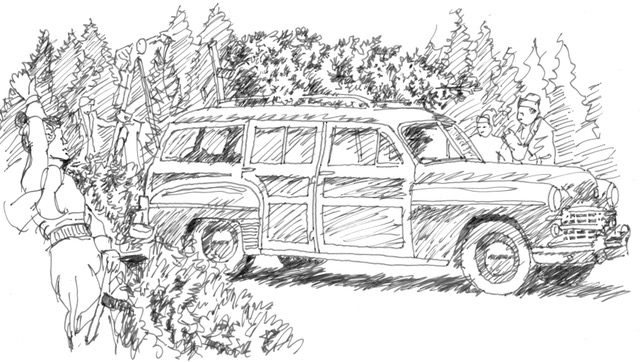
I knew the scene I envisioned wouldn’t get the result I wanted. I pushed ahead anyway.
Here I was awakening late a couple of weeks before Christmas with snow out the window. Beautiful. All I needed was a brown fedora, leather work boots, a heavy duck work coat, and a vintage station wagon, with a tree on top, to complete my fantasy. I had all those.
Here I am in my late fifties creating make believe, just as I’d done as a child.
I also needed happy workers at the tree lot and an adoring family to welcome me home with the beautiful tree. That would complete my little drama, and my childhood vision of what made the perfect Christmas. An image from magazines in the sixties.
My costume, the car, and the tree are perfect. The light snow is perfect, too.
I knew my family and the people at the tree lot wouldn’t complete my imaginary image. They weren’t actors that I’d hired for a client shoot. I knew the concept was flawed.
Flawed? No, not flawed; it was my own need I had to fill, whether or not others participated.
I knew all this as I pulled on my heavy leather work boots and felt the texture of my wool socks pressing against my ankles. Then down the stairs to the kitchen, where I announced, “I’m off to get the tree,” and “I’m taking the Dodge.”
Without waiting for a reply, I pass through the dining room to the vestibule for my coat and to wrap my old green scarf. Then out the door, down the steps to the garage where my 1949 Dodge waited.
Seeing the old car pushed away my doubts. I feel proud to own her as I open the garage door and see the blue cast from the snowy light reflected on her rear fender — a nice contrast with the warm sienna of her wood-framed sides.
Pushing the pleasure aside for a moment, I needed focus now. One must plan carefully to start and drive an old car; they’re always tricky. As I slip into the front seat, I remember the steps.
Pull the choke all the way out — two pumps of the gas pedal. Key turned on, press the starter button, and hope.
She catches on the first try. I push the choke in halfway to keep her on fast idle, slip the gear lever into reverse, and back her out onto the apron to warm up. Set the heater to defrost and turn on the fan. All okay, I open the door and step out to let her warm a bit, the vapor from the exhaust circles up into the lightly falling snow. Snow that’s just barely covering the streets.
Must be just below freezing here.
The tree lot isn’t far. Just over the hill and down in the valley. Only one stop sign between here and there. That stop is tricky, being on a hill. With the danger of spinning the wheels on the slippery surface, or worse, stalling and, in panic, flooding the engine, clearly in mind, I set out.
These thoughts, which I enjoy, keep my head out of the inevitable disappointment I know is guaranteed. Operating the car. Knowing its quirks. Feeling the accomplishment and the sense of mastery. Appreciating its beauty, style, and the craftsmanship that went into making her are all part of my pleasure.
The tree lot is jammed with people and cars. It’s slightly warmer here, and the lot is a sea of mud. The workers are tired, cold, and wet. Working for minimum wage. Hoping for tips.
No one notices the Dodge –– as expected.
I pick out the best tree I can, and with the help of a worker, tie it to the top of the car and give her a big tip. She smiles not at me but at the hundred-dollar bill.
My imagined image of happy people at the lot gathered around the car to admire and congratulate me on my good fortune remains a fantasy.
I get back in the car, praying she’ll start. My now-wet, muddy boots drip onto the floor mat. The pleasure of the experience pushed aside for the moment, replaced by anxiety at my overwrought display.
Again, I focus on the steps to start the car, and put the key in the slot. Turn it on. Press the gas pedal halfway and push the starter button. She fires. Hope lightens my chest. She dies.
I feel my face flush.
I look around. No one seems to notice. Not daring to wiggle the gas pedal, I keep my foot steady, holding it at the halfway point, knowing that too much gas will flood her and too little will starve her. I press the starter button again. She fires. I give her a small squirt of gas with the pedal. She revs a bit, and I hold her steady at a slightly high idle. As my fear of stalling fades, I slowly release pressure on the gas pedal, letting the engine slow to idle, I pull the lever into first, let out the clutch, and pull slowly out of the lot.
Now the final act of my little drama approaches. In the ads where this scene originates, family and friends greet my return and joyfully help me remove the tree from the top of the car after taking a photo with smiles and hugs all around –– thank you, Norman Rockwell.
But I knew this wouldn’t happen. I knew it when I pulled on my work boots and felt the wool against my ankles. No, the family would stay inside, not wanting to be a part of my drama.
I didn’t know then why people liked me. I thought it was my style and the things I did and acquired that people admired. I didn’t know that people appreciated me because I listened; because I was deeply interested in them, because I mostly only wanted to help. I didn’t know that stuff like that was what drew people to me.
The forty-nine Dodge was beautiful, but it wasn’t why people who loved me did so. Maybe the opposite. I now think Dodge was an obnoxious display that repelled people.
It was a beautiful car, though. And I do miss her.