
Becoming: Camp
It was going-home day, just after breakfast, the sky blue and bright after a night of rain. Packing up to go home offered up new challenges. And opportunities to fail.
I was six that August. I’d be seven in a month and back living with the McCoubreys for the school year.
Our cabin counselor was all over us as we prepared to leave. He, like all the other counselors, started the morning with us standing at attention in front of our cabin, where he gave us our assignments. I imagined this was like being in the army. We each had cleaning duties in addition to packing up all our stuff. Mine was sweeping half the cabin. The floor’s broad boards were wide and dirty yellow where we walked, and a dark mud-color under the bunk beds that lined the sides. We did our cleaning duties first, with all our belongings stacked on our beds.
“Okay, men, get those sleeping bags rolled tight. There’s only so much room in the truck, so make ‘em small!” Our counselor was mainly absent. Only around for official duties, like making sure we got to sleep at night, off to breakfast in the mornings, and packing up to go home.
The word was that he spent most of his time hanging with the girl counselors.
I was happy to be going home. I’d been horribly lonely at camp and desperate to go home. Mom must have known; I got a letter from her almost every day. She wrote about home things like picking raspberries, weekend car trips, and the weather. The letters made me sad. I don’t remember getting letters from her when I was living with Grandmother.
There were things I liked at camp, like the storytelling at the nightly bonfires, the hike to Wallace Falls, and the indoor crafts when it rained, but I didn’t have any friends.
So, I spent free time with the camp goat, who was tethered to a tree on the other side of the big field from our cabins. I liked petting him and telling him things I’d discovered, though he wasn’t soft like a kitty. His body hard, his coat tight.
There were nine of us in each of the rustic cabins, plus the counselor. The walls were only one board thick. You could see through the boards where the knots had fallen out of the knot holes. The side walls had large rectangular openings with swing-down board covers we could close if it got too cold or rainy, like last night. No glass. No screens. Rustic.
There were five bunk beds in our cabin, each with musky-smelling, old feather tick mattresses –– indigo blue striped, with cotton ticking fabric –– held together with large cloth-covered buttons and thick roped edging. We slept in sleeping bags on top.
Being going home day, rolling up our sleeping bags was required. I had no idea how to roll mine. It had been rolled tight when I got it. Watching the other boys, I pushed, folded, and rolled mine as best I could, hoping it would make the cut and knowing it probably wouldn’t.
When the luggage truck arrived, we gathered around and lifted our gear up to the counselor, arranging the load. Looking at my poorly rolled bag, noting the tag, he asked, “Teddy, Teddy..?” I raised my hand, “This will not do. Roll it tight, please.” And he handed back my big, bundled, floppy mess of a sleeping bag.
Just then, one of the other counselors squeezed my shoulder and said, “Let’s see what we can do about that, Teddy. You’re Teddy, right?”
“Yes,” I said, hoping he’d roll my bag for me.
“Teddy, I’m Tom,” he said, holding out his hand. We shook.
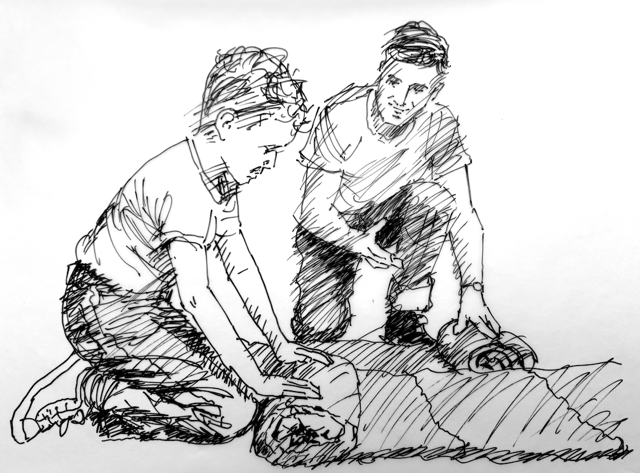
Grabbing another bag off the truck, he led me back inside the cabin, where he untied the bag and rolled it out on the floor. “Teddy, I’m not going to roll your bag for you. I’m going to show you exactly how to do it so you can do it on your own. Okay, roll yours out next to mine.”
And I rolled out my bag onto the wide boards of the cabin floor.
“Okay, straighten it out like this, then fold it in half.” He waited while I managed to get mine folded in half, lengthwise like he had.
“Okay, tug just there, and there, so the sides align…” He demonstrated, and I copied.
Over the next few minutes, Tom showed me, step by step, how to straighten and align the bag so it was ready to roll — then, using knees and hands, how to get each turn of the bag tight. And how to get the cover and the cord ties to fit just perfectly so the bag is as small and tight as possible, with the cover leaving small circles at each end, held tight with the cords tied across and around the center of the bag.
After a few tries, my bag, though not as perfect as his, was far tighter and, probably, better than most.
Tom checked his watch. “We’re late! Let’s run.”
The truck was long gone now, so we broke into a run, each carrying our newly rolled bags, past the long row of cabins, down the little hill to the main lodge, where the truck with the luggage and the bus to the station waited.
Throwing our bags onto the truck, Tom turned to me and said, “Come back again next year, Teddy.”
And with his hand on my shoulder, he directed me to the bus. I boarded after a counselor checked my name off on her clipboard. I felt a deep comfort, a warming happiness, maybe from the lesson and the moment of shared learning. A lesson that stuck.
I’ve rolled tight sleeping bags ever since, seeing Tom’s strong hands, in memory, form each roll of the bag, then hold it with his knees until it’s safely secured with the cords drawn tight.
But there was far more to that moment than the lesson.
Tom showed me how to be a kind man. A man who knew how to do things, but knew far more than those things.
He showed how to teach with care, not ridicule and blame, or threats and coercion.

2 Comments
Haha, those rustic cabins sound charming – like sleeping in a board game! And my, my, rolling a sleeping bag must be an Olympic sport I totally missed. Thanks, Tom, for the masterclass in knotting and contortion, though I’ll stick to my floppy bag next time. Almost as fun as picking raspberries at home, I guess!
Thanks! being there is what it’s all about.