Becoming: Reading the Room
“She said it was windy when they wheeled Grandmother out on the tarmac, and two big men picked her up, chair and all.”
I stopped for a moment to picture what the airport must have been like in 1950. Then, remembering Barb’s telling, I went on with…
“They carried her up the stairs. One in front holding the footrests and backing. The other, holding the handles. Grandmother, tipped way back, enduring the moment, teeth clenched, pressed her Sunday hat and her oak cane to her chest.”
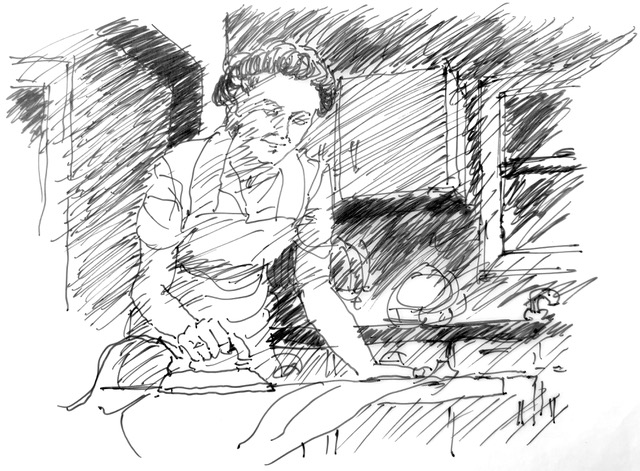
Mom put down the iron, and I wondered if it was a tear I was seeing in her eye.
I was on a roll. Not gonna stop now.
“Then Barb said, ‘Gone, damn it. Gone. Chair, cane and all.’”
Mom, having picked up the iron, seemed to be pressing dad’s pants with more rigor now. I had to say the final words. Couldn’t stop.
“Mom, Barb was so proud of you and herself, too. After years of meanness, manipulation, abuse, and violence, you were rid of her. Barb said, ‘We did it! We really did it.’”
Mom picked up shirt from the basket and began to smooth it on the ironing board. It was warm in the kitchen. I don’t know why I was so brazen that winter afternoon. Must have only been sixteen. I was leaning against the fridge as I did when talking to Mom, while she ironed. Somehow, ironing –– when Mom was ironing –– was when we had our best talks.
Dad not yet home from work, the warmth –– something on the stove or in the oven giving off those homey cooking smells –– together contribute to the possibility of conversation, the kind where real stuff can at least be approached.
We always avoided talking about anything uncomfortable, anything real or intimate in our house. But somehow on that rainy winter day, I was able to stretch the rules. I must have just gotten home from school. Dad –– still at work, he wouldn’t be home for a couple hours.
So, I asked, “Why was Grandmother so mean? Why were you and Barb so afraid of her?”
Mom put the iron down on its heel, turned the shirt over to get to the collar, and said, “Reverend Wyatt was a huge help. He’d helped us get Dad committed when he had the mental breakdown and felt Grandmother had contributed.”
She paused and looked up for a moment before continuing with, “And, Barb, with her welfare role, knew how to work the system. Barb picked Hawaii. I don’t think we’d have been able to convince Grandmother if it hadn’t been Hawaii. She’d never been there but knew it was warm and beautiful.”
Shifting my weight on the fridge, I was pretty sure I wasn’t going to get any more from her on Grandmother. Mom would hide in the facts, perhaps unable to speak of the pain and raw fear that was the story she and her sister Barbara had lived.
Even so, I had to push on.
“You know, I hated my time in California with Grandma. She was mean.”
“Teddy, I’m sorry we had to do that. With your dad in the hospital, I had to get my teaching certificate updated so I could work. That, and I had to find a job. Overwhelmed. I simply couldn’t manage all that and take care of you.”
Putting the shirt on a hanger, she concluded the conversation with, “Could you iron the rest of these? I need to finish up making dinner.”
I liked ironing. I liked the smell of the fresh, clean laundry just off the line, and the scent cotton released when the hot iron smoothed it. I especially liked ironing my Levi’s and getting the seams perfectly aligned. The kitchen, with its swing-down ironing board, tiled counter, and the grid pattern of the linoleum floor, felt safe.
Mom opened the oven and used a fork to test the meat.
As I ironed, my thoughts turned back to the conversation. I hadn’t been able to press Mom on why she didn’t take me with her to Olympia. I was afraid to ask her to tell me more. Afraid that I’d hurt her, that she’d get angry and go silent, or maybe cry. I was afraid that if I pressed her, an emotional rift between us would grow, and I needed her as an ally.
She was my buttress against Dad, at least most of the time.
Dad would be home from work soon. Mom and I swung into the roles we adopted to make everything right. I imagined it must have been like the emotional management of Grandmother Mom and Barb had learned as girls.
Now, decades later, I’m beginning to understand why I pressed further on what happened, and how it shaped me. I think I learned to mimic Mom’s careful emotional management of Dad, a skill she probably learned from managing her mother. From our conversations, I learned when to ask and when not to. When to press forward, and when not. Most of all, how to not step over that invisible but very real line between everything being okay and rage.
Mom and her sister Barb showed me how to be professionally conversant. Both were college graduates, Barb with a master’s in social welfare, and Mom with a teaching degree and a minor in English.
Decades later, Barb’s partner, Cynthia, gave me a copy of their unpublished memoir. In one passage, Barb describes Grandmother, in a rage, swinging Betty (my mother) and herself around the room by their hair.
In Barb’s telling, she and Mom lived under the constant threat of Grandmother’s violent outbursts. Barbara left home on a motorcycle when she was fifteen, never to return. Betty was the perfect student, graduating cum laude, only leaving home in her early thirties to marry.
At five months, I was adopted into this family and grew up in the wake of these three women: Grandmother, Barbara, and my mother.
I sorted the freshly ironed clothes, raised the ironing board, and closed it into its cabinet, thinking: Mom, Barb and Grandmother shaped me; then there’s Dad.
Born into poverty, his parents died early in his life. His sisters raised him, and as a young man he survived the Depression by riding the rails, finding only occasional work. He was then sent to the Pacific war as a Seabee, a time he never talked about.
Maybe, I thought, picking up the basket of folded clothes, being quick to violence had kept him alive. Shit.
Looking back, it seems the war could certainly have resulted in PTSD and the mental breakdown that happened when I was four. He could be violent. But it was mostly the threat of violence that kept Mom and me attentive to maintaining the emotional equilibrium.
Now I think of this as a management training course… named childhood.