Becoming: Barb Was the Power
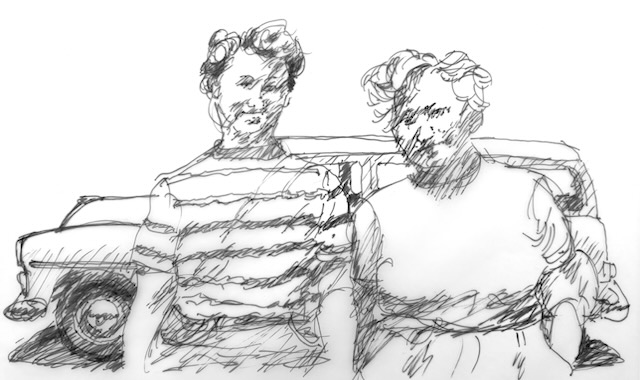
“Teddy, Barb had just turned fifteen when she left home on an old motorcycle. She never returned.”
Mom paused and looked out the window at the gray day.
“That was a long time ago. 1928.”
This was news to me, but not surprising. I already knew that when she was young Barb had made money parachuting out of biplanes at county fairs.
We were sitting at the Formica table in the kitchen of the little house on Pearl. Dad had died a week earlier, not unexpectedly. We were preparing for the funeral. Barb and her partner Cynthia were flying up. Mom and I were about to leave for the airport.
Barb’s decisiveness, her power to act, her rejection of convention — none of that surprised me. It was always fully on display, along with a gentle caring nature that was how she was with me.
Sometimes I craved it. I wanted to be with her. I wanted to be as articulate and persuasive as she was.
But I was also desperate to belong to the establishment.
Barb had a deep impact on me. And yet, over the fifty-five years we shared — from 1945 until her death in 2000 — I probably saw her only twenty times. I don’t remember a single Christmas or Thanksgiving dinner together.
What I do remember is that when she focused on me, she was fully there.
The First Dance
I’m four. It’s 1949.
Barb has just come into our living room after work. She says a few words to Mom and Dad, then turns to me.
“Let’s play Ring Around the Rosie.”
She takes my hands and begins to sing.
“Ring around the Rosie, a pocket full of posies…”
We go round and round until —
“…we all fall down.”
Down I go onto the soft rug, giggling with the happiness of it all. I’m in love.
And we danced and danced.
I didn’t know the song. But Barb did.
It was late on that winter day. Dark in the living room. Only the small lamp on Dad’s desk was on. Barb was wearing her Traveler’s Aid uniform. Dark blue.
Mom broke the moment.
“Teddy, it’s long past your bedtime. Kiss Aunt Barbara and off to bed.”
Barb was staying in the downstairs bedroom. The same room Mom and Dad had painted pale blue when we moved in.
We’d moved to the new house, as Mom said, “So you can have your own bedroom, Teddy.” Mom went on to explain that the adoption agency required that I have a separate bedroom. It was in the contract.
Heading up the stairs, I was already thinking about the drawing I could show Barb.
She always asked questions about my drawings.
The Drawing
“Where is the horse going, Teddy?”
“He’s going home,” I said. “And he’s a doggie. Not a horse.”
“Well…” Barb always spoke with these long, wonderful pauses. “I thought she was a horse because you drew a saddle. Is that a saddle?”
“It’s a coat. It’s winter and she’s cold.”
I felt a little shame that my doggie looked like a horse.
“Arlene puts coats on the doggies when they go outside.”
Arlene was Barb’s closest friend.
“That’s right,” Barb said. “You’re right, Teddy. It was freezing the day you visited the kennel.”
I asked if I could ride in the back of the van with the dogs again.
I loved it there — my face pressed against the mesh screen, the dogs wiggling and squealing and pushing against me, competing for the biscuits Barb passed through.
I didn’t know then that Arlene had been Barb’s lover.
Soon Barb was gone again.
She had met Marge.
The Rescue
Mom explained what would happen next.
“You’ll be taking the train to Monterey with Grandmother. It’s warm there.”
Grandmother used a cane to walk, to threaten, and sometimes to poke. Once when she poked me, I ran away and climbed a chestnut tree, hiding there most of the day.
Seeing my expression, Mom said carefully: “I know she can be harsh. But she loves you.”
Dad had already left by then after what Mom called a “mental breakdown.” Mom had gone back to school to renew her teaching certificate and had taken a job in Olympia. I couldn’t go with her.
So, I lived in Monterey with Grandmother for a year.
Kindergarten. Rain. Loneliness.
Then, when school ended, Barb arrived.
Barb and Marge drove down in their Plymouth wagon, which they had named Meg.
I had been waiting and waiting for them.
Not sure they would really come.
But they did.
Grandmother packed my things. Marge loaded the car.
And suddenly we were heading north.
Back to Seattle. Back to my room. Back to safety.
I sat between Barb and Marge on the broad front seat. It was warm and comfortable. Their voices, the sound of the motor, the movement of the road — it all felt safe.
I was with them.
Years later Barb told me something I hadn’t known.
“Teddy, every time we stopped for gas, I worried about the men’s room.
“I kept a big wrench in the back.
“I’d walk you to the door, open it to see if anyone was inside.
“Then I’d wait outside holding the wrench.”
Barb had been protecting me the whole way home.
She was my hero.
The Boat
When I was seven or eight, we visited Barb and Marge at Lake Chelan.
They had a long narrow boat called The Russler.
Chelan is fifty-five miles long and squeezed between steep mountains. In the afternoons the wind pushes hard rollers down the lake.
The Russler was designed to cut through those waves. In theory.
In practice we never got a chance to test her; the engine broke down almost every trip.
“Shit,” Barb would say, lifting the engine cover.
Gasoline smell filled the air.
She’d check her watch, thinking about the wind, then start adjusting things with a screwdriver Marge handed her.
“Okay, hit the starter.”
The engine sputtered.
“Hold it,” she’d say. “Let me try something else.”
This went on for a while until finally Barb wiped her hands on a rag and said calmly:
“We better flag down the ferry.”
Watching her I saw something I never forgot.
Barb didn’t panic. She didn’t rage.
She simply worked the problem until it was time to change the plan.
She always knew what to do.
The Break
“She’s strange.”
I was fifteen.
Dad said it after I’d been talking about Barb and how powerful she was. I was trying to place myself in her camp — the strong one — not his.
He continued. “She’s queer. A dyke. A lesbian. You don’t want to associate with people like that.”
It hit me hard.
By then I had already had a couple of men come on to me. It was confusing, embarrassing, frightening. A place I didn’t want to go.
And suddenly my Barb was part of that world.
In that moment I deserted her.
I stayed away for years.
The Return
In my twenties the shame of that decision finally caught up with me.
I went back.
Barb greeted me with a huge hug.
No lecture. No distance.
Just Barb.
The power was still there.
And the love.