What’s actually happening when your plan goes nowhere — and what to do about it.
Planning to acquire? Got a new product or service to launch? Thinking of entering a new market?
You’ve tested your assumptions. You know your plan is sound. You know that with the turmoil in the marketplace, you must evolve to grow. That survival is not a sure thing.
You turn your plan over to your leadership team to launch.
Six months later, it’s going nowhere.
The sales team isn’t selling it. Creatives are loath to work on it. Marketing isn’t promoting it. Account isn’t talking about it with clients.
When confronted, they insist it’s a priority. Each is telling their teams to focus on it. Yet somehow, everyone consistently avoids action.
When you intervene, you can easily get people to understand and agree your plan is sound. Nothing seems to help. Training, performance bonuses, directives — all go nowhere. Worse, you can’t identify any one person or group actively blocking the plan.
And then you remember: when you founded the company, everyone thought you were crazy. Family, friends, colleagues, even early employees. They all thought you were nuts.
Now that you’re successful, and you suggest you need to pivot, many of the same people — including your leadership team — resist. Because, you intuit, “we can’t risk what we’ve built.”
They’re protecting something that exists only because you took the “crazy” risk they all thought was impossible. Now they think you’re reckless. They can’t seem to appreciate how many times they’ve benefited from you pushing through the impossible to get to new success.
You feel the stress your demands are putting on leadership. It’s as if they were being torn between two authorities. But who, exactly, was this other authority? Like so many founders, you’d assumed that being in charge meant the organization would respond to your insights. How could it be that you have all the control on paper but so little in daily practice?
If the Person at the Top Isn’t in Charge, Who Is?
The culture.
You’re wrestling with a different kind of living being: one that developed its own character, its own preferences, and its own will. Your personal ethos of innovation is at war with your organization’s character, which craves safety, certainty, and predictability. The fact that you created it matters very little.
Organizations maintain legal and cultural boundaries that define who’s inside and who’s out. They mix capital, talent, and material into products and services. They grow through hiring, adapt to market pressures, start subsidiaries, and acquire others. A company’s culture emerges from thousands of daily interactions, but can’t be found in any employee handbook or org chart. And when threatened, organizations exhibit a tenacity that can override the preferences of any individual within them.
Even the leader.
What to Do
Get curious before you get strategic.
The resistance isn’t defiance. It’s information. The culture is telling you something about itself: what it fears, what it values, what it believes it cannot survive without. Your job, before anything else, is to understand that.
Not from a distance. Not through a survey or a town hall or a reorganized org chart.
One conversation at a time.
I’ve been doing this work for forty years, and I’ve never seen a culture shift from a directive.
I have seen it shift from a single honest conversation someone didn’t expect to have. A creative director who finally said what she’d been holding in for two years. An account lead who admitted he didn’t believe in the new direction because no one had asked him what he thought. A COO who was protecting her team from what she assumed you’d do with the information.
These people aren’t your problem. They’re your path.
The question isn’t why they’re resisting. It’s what do they know that you don’t?
Sit with that long enough to mean it. Then go ask.
What you’ll find, almost always, is that the resistance has a specific shape. It lives in particular people, in particular fears, around particular losses, real or imagined. Once you can see its shape, you can work with it. You can’t work with what you’re busy overriding.
Now Show Them What’s Possible.
Not as an argument. As a story.
Find the firms that made the move you’re asking your people to make, and lived to say it was worth it. Tell those stories in rooms where your people can hear them. Not as proof that you’re right. As evidence that the fear is survivable.
Then go further. Help them see the future you’re building, specifically, concretely, with them in it.
Not the strategy deck version. The human version.
What does a Monday morning look like two years from now if this works? Who’s doing what? What did we build that we couldn’t have built any other way? What did we stop being afraid of?
People don’t move because the logic is sound. They move because they can feel the future… and because they can see themselves inside it.
That feeling can’t be installed. It must arrive on its own terms. Your job is to create the conditions for it.
Stories do that. Honest conversations do that. Being seen does that.
What you’re building toward isn’t compliance.
It’s a room full of people who have each, privately and in their own time, come to the same conclusion: yes. This is the right way forward. And it includes all of us.
That’s a different kind of momentum than anything a directive produces. It’s slower to start.
It doesn’t stall.
You already know how to do this. You did it when you founded the company: you persuaded people, one at a time, that the impossible was worth trying.
That’s still the work. It’s just aimed inward now.
I’ve been working on something longer.
For forty years I’ve been watching what happens underneath the visible problems in creative firms. The stalled initiative. The leadership team that agrees in the room and disappears in the field. The founder who has all the authority on paper and almost none of it in practice.
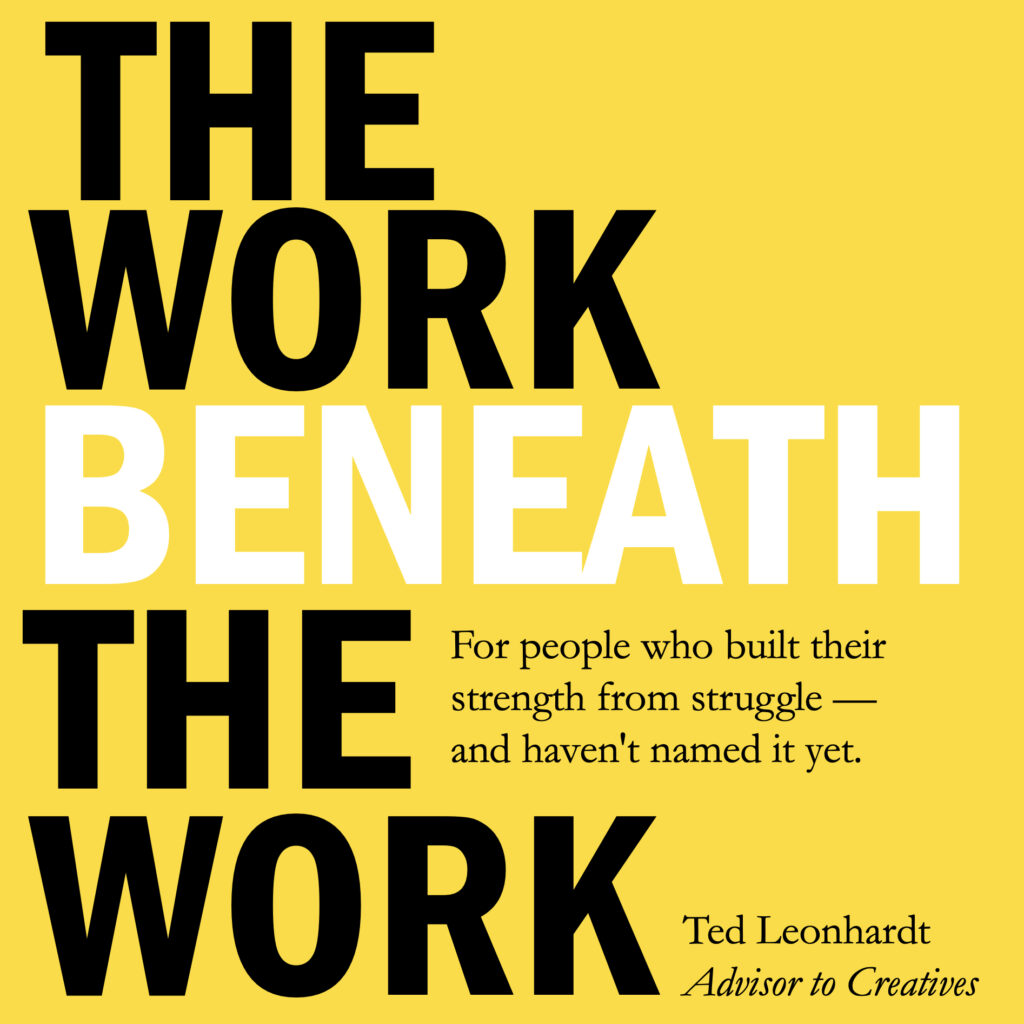
The book is called The Work Beneath The Work.
The subtitle is: For people who built their strength from struggle — and haven’t named it yet.
I’m 80. I couldn’t have written this earlier.
One more thing.
I have six cover directions and I’m genuinely undecided. I’ll share a few here soon and ask what you think. Your instinct matters to me.