Up the stairs.
Happy to be off the street. It’s become a rough neighborhood again. Panhandled three times between parking and finding the entry.
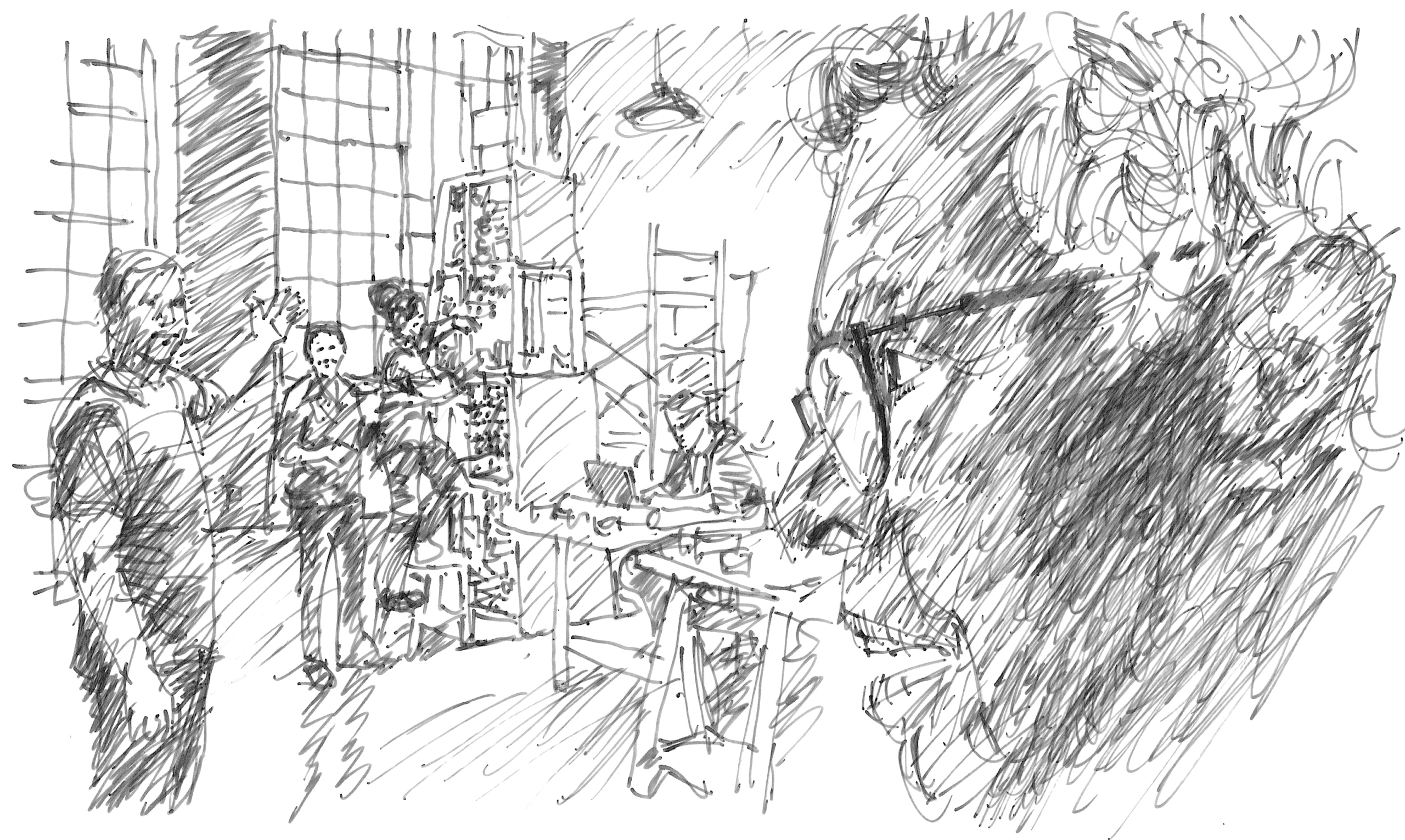
Buzzed in, I noticed the fresh paint and new sisal runner as I climbed. Reaching the second floor, I entered to find high ceilings and what had to be a fabrication in progress — a tower of some kind, half-built, dominating the center of the room.
My client Jenn, a pseudonym, smiled when she saw me from across the floor and gestured toward it. “Ted, don’t you love it! We’re boxing it for a B2B event in Omaha. It’s gotta get off tomorrow. I’m glad you got to see it.”
There it is, I thought. B2B. And it looks like a hell of a good time.
The End of an Era
I sold my firm years ago. To a holding company, as it happens — the same kind of company that has since acquired Turner Duckworth, JKR, and hundreds of others. I understood the impulse completely. You build something, you pour decades into it, and one day someone offers to turn that into money you can actually hold. You take it. I took it.
What I didn’t fully get at the time was what gets lost in that transaction. Not immediately — the work continues, the people stay for a while, the name remains on the door. But holding companies are not built to sustain creative culture. They’re built to extract value from it. Those are different projects, and eventually the difference shows.
Turner Duckworth and JKR were trophy acquisitions — not distress sales. The founders were rewarded. The work had been extraordinary. But the era those firms represented, the era of the large prestigious B2C creative firm as the pinnacle of the industry, is closing. Not because the work got bad. Because the model got old.
The Seeds of What’s Next
WPP, Omnicom, Publicis and the large independents like IDEO have shed hundreds of thousands of jobs over the past several years. That talent didn’t vanish. It dispersed.
Some of it started something new. Some of it landed in smaller firms. In the Seattle metro area, where I worked, the Seattle Creative Directory lists over 200 small creative firms. As far as I know it’s unique — I’m not aware of another major market that catalogs its creative community this specifically. But I think of it less as a local curiosity and more as a window into what is probably true in every significant city. The fallout from the holding company era is out there, building things, finding footing.
A few of those 200 firms will grow into the next generation of significant creative companies. Not most of them. But some.
Understand the Moment
The question is which ones — and why.
It won’t be the firms with the best work, necessarily. It will be the firms whose leaders understand what moment they’re in.
B2B creative spending is growing fast. Budgets are increasing. The work is becoming more sophisticated — experiential, brand-driven, content-heavy, increasingly complex. And the premium on genuine human creative judgment has never been higher, precisely because AI has commoditized the cheap end of the market. Clients who want real creative thinking know they can’t get it from a prompt.
But here’s the problem most creative firm leaders haven’t solved yet: their best people didn’t get into this industry dreaming about B2B. They came up worshipping the work Turner Duckworth did for Coca-Cola, and the best from IDEO. The visual systems JKR built for global consumer brands. That’s what drew them to the craft. Telling them the future is B2B can feel, if it’s not framed right, like a consolation prize.
The leaders who figure out how to reframe that story — who can make B2B feel like a creative frontier rather than a fallback — will keep their best people. And keeping your best people, in this AI era, is the only durable competitive advantage a creative firm has.
Creativity in Bloom
Back in Jenn’s studio, watching her team work around the tower, I noticed something. Nobody in that room looked like they were settling. They looked like people doing work that mattered, solving a problem with their hands and their eyes and their judgment, enjoying the comradery, the pleasure of doing something cool, together.
That’s the story worth telling your people.
The large firms consolidated. The holding companies extracted. Talent scattered, landed and started building again. And the work — the real work, the work that requires a human in the room with taste and nerve and the ability to read what a client actually needs — that work is growing.
The neighborhood outside may be rough. But upstairs, something is alive.